
By ekko Editorial Team · Updated 2026-09-04
Consistent LinkedIn visibility drives measurable B2B sales conversations by keeping reps and leaders top of mind before prospects ever take a call. LinkedIn ranks as the top platform for 44% of B2B marketers. We equip every seller with a daily, compliant post drafted in their own voice through ekko’s Profile Brain, turning individual profiles into steady pipeline-building assets.
Key Takeaways
- B2B sales involves companies selling products or services to other businesses across tech, manufacturing, healthcare, and services industries.
- Social selling builds relationships and trust through valuable insights, not cold calls and generic email blasts.
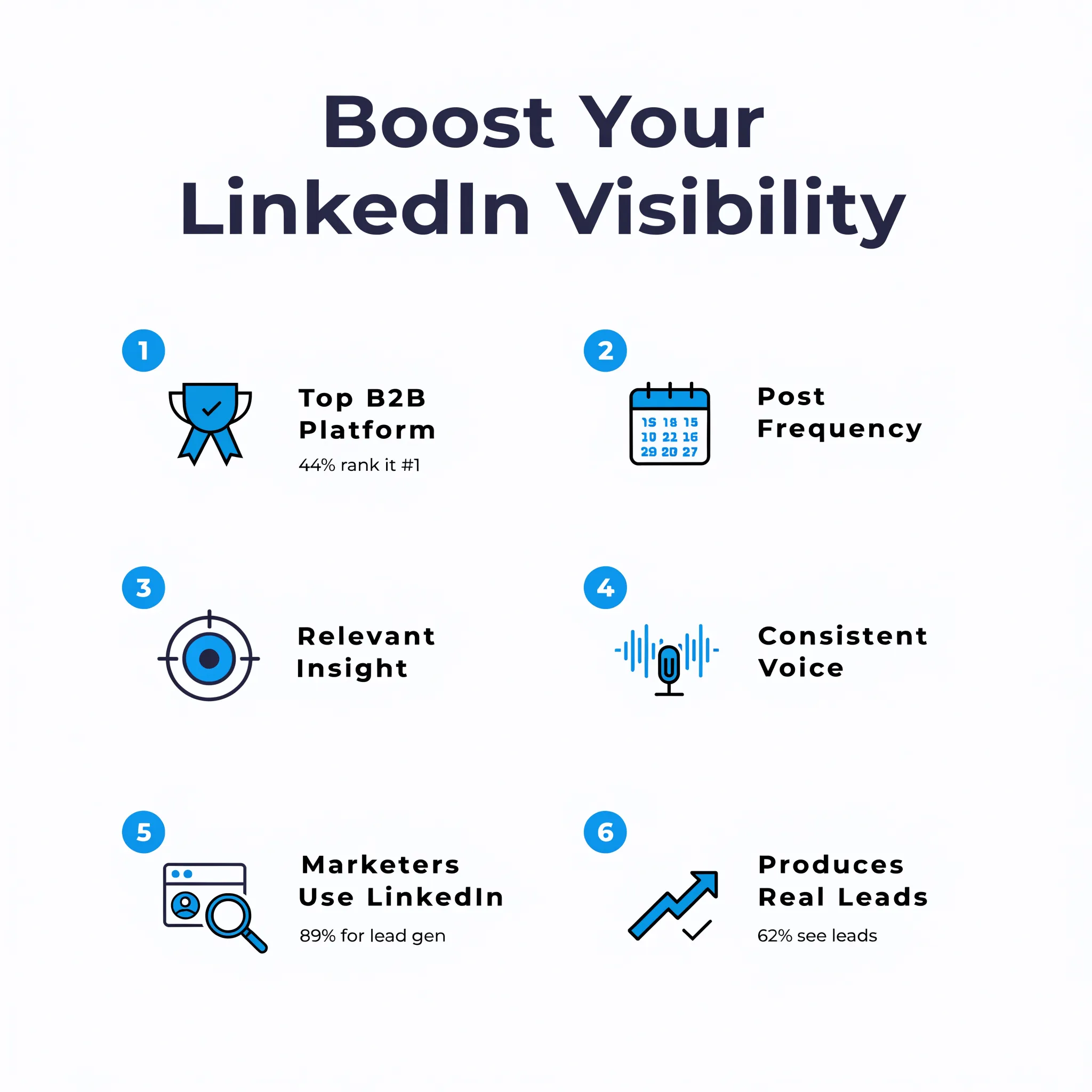
- According to Salesgenie’s research on LinkedIn prospecting, 89% of B2B marketers rely on LinkedIn for lead generation, and 62% report it actually produces leads.
- LinkedIn prospecting deserves a central place in B2B go-to-market plans as a source of qualified leads.
Why Does LinkedIn Visibility Drive Sales Conversations?
Visibility on LinkedIn shortens the distance between a first impression and a first conversation. B2B sales cycles on LinkedIn stretch across weeks or months, often involving procurement teams, technical evaluators, and finance approvers, each weighing a different set of priorities before signing off. Staying visible through that stretch keeps a sales professional in consideration long after the initial outreach message fades from memory, and it means a seller often needs to earn trust with several people inside the same account, not just one champion.
Why does LinkedIn matter more than other channels for B2B sellers?
Marketers already vote with their budgets. In 2024, 44% of marketers ranked LinkedIn as the top social platform for B2B businesses and professionals, ahead of every other channel measured, according to Salesgenie’s research on LinkedIn prospecting for B2B sales teams. That ranking reflects where buyers actually research vendors, compare credentials, and form early opinions before a single call happens.
We treat that visibility gap as the real cost of inconsistent posting. A sales representative who disappears from the feed for three weeks loses the compounding effect that steady LinkedIn content for sales builds over time. Prospects notice absence just as much as presence.
Three factors separate sellers who convert visibility into pipeline from those who don’t:
- Frequency — posting on a predictable schedule, not in scattered bursts
- Relevance — sharing insight tied to a buyer’s actual business problem
- Consistency of voice — sounding like the same person in every post
We built ekko to remove the friction behind all three. Every morning, ekko delivers an on-brand, compliant post paired with a matching visual directly to a sales professional’s inbox. One tap publishes it. That single action keeps LinkedIn sales conversations starting on schedule, without asking sellers to become writers or designers.
Does posting frequency actually influence pipeline?
Frequency alone will not close a deal. Absence, however, removes a seller from consideration before a conversation even starts. That silent cost rarely shows up in a pipeline report, yet it shapes which vendors get the first call.

What Makes B2B Sales On LinkedIn Different?
One company sells to another company, not to an individual consumer, and that distinction shapes every interaction on the platform. Business buyers evaluate vendors on behalf of teams, budgets, and long-term outcomes, not personal preference. That difference changes what a sales post needs to accomplish.
Longer sales cycles, multiple decision-makers, and heavier negotiation define LinkedIn for B2B sales in ways consumer marketing never has to address. We treat these conditions as the baseline for effective B2B sales on LinkedIn, not an exception to plan around. Winning here depends on building real relationships and matching solutions to a specific business’s needs, rather than pushing a generic pitch at scale.
Why does relationship-building matter more on LinkedIn than other channels?
Buyers on LinkedIn are researching vendors, comparing expertise, and vetting credibility before a conversation ever starts. A post that demonstrates genuine understanding of an industry problem earns more trust than a feature list. That trust is what eventually turns LinkedIn sales conversations into pipeline.
How does content consistency affect B2B credibility on LinkedIn?
Consistency signals that a company knows its own business inside and out. When corporate knowledge stays centralized, every seller’s posts stay factually aligned, and nobody has to chase marketing for talking points. This is the same logic we apply to LinkedIn content for sales:
- Facts stay consistent across every voice on the team
- Sellers spend less time verifying claims before posting
- Marketing fields fewer one-off requests for updated messaging
Strong LinkedIn personal branding for B2B sellers grows out of that consistency, not around it. Get the shared facts right first; the individual voice can layer on top.

How Does Personal Branding Open Sales Conversations?
Credibility precedes contact. Buyers research vendors, compare expertise, and evaluate industry credibility on LinkedIn before a single message gets sent, which turns a well-built profile into a qualification factor rather than a formality. LinkedIn personal branding works because it answers the buyer’s diligence before the rep ever asks for time.
That research phase means the profile has already done half the selling. A sales representative with a thin, generic presence signals low investment. One with a distinct, consistent voice signals expertise worth a reply. We built ekko’s Profile Brain to protect that distinction. It studies each person’s sentence length, hook style, and punctuation habits from their own published posts, so the voice on the page matches the voice buyers expect to meet.
Why does voice consistency matter more than post frequency?
Frequency without authenticity erodes trust faster than silence does. Buyers notice when a “personal” post reads like a corporate template. That mismatch weakens the credibility signal LinkedIn was supposed to build. Each Profile Brain runs as a private, person-specific model, never shared across the team, which keeps every rep’s voice distinct instead of homogenized into brand-speak.
Does posting consistency actually improve results over time?
Yes. Voice accuracy compounds with repetition, and drafts sharpen as the model learns from every new post. Week four consistently outperforms week one, meaning LinkedIn content for sales teams improves the longer a rep stays active rather than plateauing after the first few posts.
For sales leaders managing B2B sales engagement at scale, this compounding effect matters more than any single viral post. A pipeline of representatives building recognizable, credible voices over months creates a durable advantage in LinkedIn lead generation — one that generic, one-off content can’t replicate. The conversation starts before the DM, in the profile the buyer already trusts.

What Content Turns Connections Into Conversations?
Relationship-driven posts, not cold pitches, turn connections into conversations. Social selling replaces cold calls and generic email blasts with relationship-building. Insight-sharing earns buyer trust before a LinkedIn sales conversation ever starts. That distinction separates a feed full of noise from a feed that builds B2B sales engagement over time.
Three qualities separate content that converts from content that gets scrolled past:
- Relevance — insight tied to a prospect’s actual business problem, not a generic pitch
- Consistency — a steady presence, not a burst of posts followed by silence
- Voice — writing that sounds like the person behind the profile, not a template
We screen subject matter before drafting. Every post reflects a topic worth a prospect’s attention, filtering out material that dilutes trust instead of building it. That screening step is the difference between LinkedIn content for sales that reads as expertise. Content that reads as marketing collateral wearing a name tag.
Does converting connections require constant writing?
No. Publishing takes a single tap and roughly sixty seconds a day, with no writing or design required on the seller’s end. Every draft arrives with a feed-ready graphic already applied, removing the separate design step that keeps most sales teams from posting consistently. No designer, no design skills, and no workflow outside the daily draft stand between a rep and a published post.
We built this process around avoiding generic chatbot output, replacing it with drafts shaped by each seller’s own voice and posting history. That fidelity matters for LinkedIn personal branding: prospects notice when a profile sounds authentic across months, not just once.
For executive teams, the primary outcome is a personal brand that reinforces the company’s positioning instead of competing with it, strengthening both LinkedIn for B2B sales efforts and B2B sales on LinkedIn at scale. Consistent, on-voice content, published daily, is what steadily feeds LinkedIn lead generation — one earned conversation at a time.
How Do Three AI Layers Keep Posts Compliant?
Three distinct AI layers screen every draft before publication. Corporate knowledge, compliance rules, and individual voice each contribute a separate check, and no post skips the sequence.
The division of labor is deliberate. One layer knows the company. A second layer knows the rules. A third layer knows the person. Together, these layers define the core value proposition of screening subject matter before drafting: nothing gets written until the facts, the restrictions, and the voice have all been confirmed.
The corporate layer holds a single source of truth for the organization. Offerings, value propositions, target industries, and approved terminology. We load this information once, and every draft pulls from it automatically. This keeps LinkedIn content for sales consistent across an entire team, so a representative in one region and an executive in another describe the company the same way.
The compliance layer works differently. Prohibited claims, restricted topics, regulatory language, and confidentiality rules get enforced before a draft is written, not flagged after the fact.
Does compliance screening slow down publishing?
No. Because prohibited claims and restricted topics are filtered before drafting begins, the finished post arrives already cleared. Sales teams skip the delay of a separate legal or marketing review cycle, which keeps B2B sales engagement moving at the pace the platform demands.
The third layer protects voice, and this is where we highlight our commitment to avoiding generic chatbot output. Rather than generating a templated post, this layer studies how a person actually writes and shapes the draft around that pattern. LinkedIn personal branding stays intact instead of flattening into something that reads like every other post on the feed.
Together, the three layers work invisibly. Users see none of the underlying machinery — only a finished post that already sounds like them and already meets company standards, ready for real LinkedIn sales conversations the moment it goes live.
How Does LinkedIn Prospecting Fuel Lead Generation?
Prospecting turns LinkedIn from a static resume site into a revenue engine. Salesgenie’s research on LinkedIn prospecting for B2B sales teams calls it the practice of finding and connecting with ideal business buyers to start quality sales conversations. That definition sets the foundation for everything else on the platform. We treat this as the starting point for LinkedIn for B2B sales, not a side tactic bolted onto email outreach.
Companies selling to other businesses cannot treat prospecting as optional anymore. Salesgenie’s data on B2B sales on LinkedIn places prospecting at the center of any credible go-to-market plan. Buyers already use the platform to research vendors, compare expertise, and judge industry credibility before a rep ever reaches out. That behavior shift means the sales team that shows up with insight wins the meeting. The one that shows up cold does not.
The numbers back this up. Salesgenie reports that 89% of B2B marketers rely on LinkedIn for lead generation, and 62% say it actually produces leads. Few channels combine that level of adoption with proven output.
Why Does Scale Matter for Prospecting?
Scale determines how many qualified buyers a sales team can reach without expanding headcount. LinkedIn has reported surpassing one billion members worldwide, giving sales organizations a pool large enough to consistently find decision-makers, nurture relationships, and move deals toward close.
What Makes a Prospecting Effort Effective?
Effective prospecting depends on consistency, not volume alone. Our platform supports three habits that separate results-driven teams from the rest:
- Researching each account before initiating contact
- Publishing relevant insight that opens LinkedIn sales conversations naturally
- Following up with context tied to the buyer’s stated priorities
What Drives Consistent Sales Engagement Over Time?
Consistent B2B sales on LinkedIn depends on removing friction between insight and publication, not on posting frequency alone. Sales professionals abandon the platform when drafting eats into selling hours, and momentum collapses within weeks. Ekko closes that gap: a finished post, written in the professional’s own voice, lands in the inbox each morning, ready to publish in under a minute.
Voice fidelity compounds the effect over time. A dedicated Profile Brain studies each person’s posting history and sharpens with every published post. LinkedIn content for sales teams grows more accurate the longer representatives stay active. Week four outperforms week one, and that improvement curve keeps engagement climbing instead of flattening.
Why does draft quality matter for engagement?
Draft quality determines whether a post sparks LinkedIn sales conversations or scrolls past unnoticed. We screen subject matter before drafting begins, matching every topic to something genuinely worth a prospect’s attention before a single word gets written.
What Should Sales Leaders Do About Visibility Now?
Sales leaders must treat LinkedIn personal branding as infrastructure, not an occasional task squeezed between calls. Delaying consistent LinkedIn content for sales only widens the visibility gap between reps who post and reps who go unseen. Every quarter without a system costs pipeline that a competitor’s rep is quietly building post by post.
We built ekko from Frisco, Texas, in partnership with CAP Digisoft, a Dallas-based software engineering firm with more than 20 years of experience building reliable business software, to close that gap for revenue teams, not just individual creators. That engineering pedigree, combined with ISO-certified data protection standards, grounds a platform designed for teams that need speed, structure, and accountability, not another tool that demands hours of manual writing.
How fast can a sales team start?
Starting requires no sales call and no lengthy onboarding cycle. A leader signs up, connects a LinkedIn account, and receives a first drafted post before setup even finishes. That speed matters when B2B sales engagement depends on staying visible every week, not launching a campaign months from now.
Who reviews a pilot or compliance request?
Teams weighing a team pilot, a leadership program, or a compliance review get a response from the right person within one business day. No queue, no generic support ticket routing.
Sales leaders evaluating visibility today should move through a simple sequence:
- Identify which reps and executives most influence LinkedIn lead generation for the pipeline.
- Connect their profiles and confirm the drafted voice matches how they actually write.
- Route any compliance or leadership-program questions to Ekko directly and expect an answer within one business day.
- Publish consistently rather than in bursts, since sporadic posting undercuts the trust that steady B2B sales on LinkedIn activity builds over time.
Visibility rewards teams that act now, not teams that wait for a perfect quarter to start.
FAQ
Why does LinkedIn visibility matter for B2B sales conversations?
Consistent visibility keeps sellers top-of-mind before prospects ever take a call, shortening the distance between a first impression and a real conversation. It helps sellers stay in consideration through long B2B sales cycles involving multiple decision-makers.
What three factors help sellers turn LinkedIn visibility into pipeline?
Frequency, relevance, and consistency of voice separate sellers who convert visibility into pipeline. This means posting on a predictable schedule, sharing insight tied to buyer problems, and sounding like the same person every time.
How does Ekko help sales teams stay visible on LinkedIn?
Ekko’s Profile Brain delivers a daily, compliant post in each seller’s own voice, paired with a matching visual, directly to their inbox. One tap publishes it, removing the need for sellers to write or design content themselves.
Conclusion
In closing, the intersection of consistent LinkedIn visibility and authentic professional voice fundamentally reshapes how B2B sales conversations initiate and develop. Organizations that prioritize strategic content distribution across individual profiles establish credibility, accelerate relationship building, and create measurable competitive advantage in their respective markets. The path forward requires commitment to voice fidelity and systematic content governance—not generic automation. This approach transforms LinkedIn from a passive networking platform into an active revenue-generation channel.